
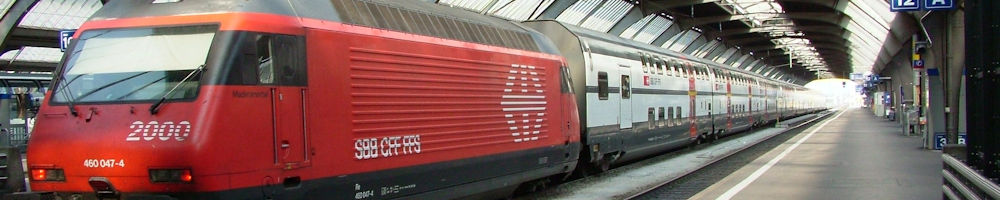
Swiss Railways train in Zurich Station

The “Reseau European en Train” https://reseauentrain.eu/?p=2434 and “European Rail Campaign (UK)” both promote rail as the preferred means of sustainable transport. However, this does not stop at transport alone but also considers its relationship with the territories (its effects on daily life, development and tourism in the regions served) and with other modes of transport. In this case, this statement focuses on the interaction between trains and passenger ships.
Definition and context – a few figures:
This statement focuses on regular passenger transport by ferry, which provide regular passenger services by sea (more rarely by river), but excluding tourist cruise ships.
In the EU, these services carried 220 million passengers in 2024, and in the United Kingdom, 53 million passengers (38 million domestic and 15 million international.) In the UK, the main origin or destination country is (by far) France, followed by Ireland and the Netherlands.
Compared to the countless daily journeys made by train and especially by car, and relative to the population (450 million inhabitants for the EU, 68 million for the United Kingdom), these figures remain modest, as they mean that an inhabitant only takes the ferry once every two years on average. Nevertheless, this mode of transport is of vital importance for accessing a number of island territories, both for tourism and for the daily lives of residents. In the EU, the three countries with the most boat journeys, namely Italy, Greece and Denmark, which have an extensive network of islands that are connected by ferry. In the British Isles, ferries play the same role: they connect England not only to continental Europe and Ireland, but also to other British islands, notably the Isle of Wight, opposite Portsmouth, which has the highest volume of domestic traffic.
Relevance and sustainability of passenger transport by boat:
Furthermore, transport by boat is not easily replaceable.Sea crossings could only be replaced by either flying or building costly tunnels or bridges that are not without environmental damage, such as the Fehmarn Tunnel, currently under construction between Germany and Denmark. If these structures include a road link, which, with the exception of the Channel Tunnel, is always the case, they encourage an increase in road traffic.
According to the European Environment Agency, travelling by sea emits an average of 61 grams of greenhouse gases per passenger-kilometre, which is more than the train (33 g) but much less than the coach, the private car and almost three times less than the airplane (80, 143 and 160 g respectively). According to these figures, boats are the means of transport with the lowest greenhouse gas emissions apart from trains. This can be accounted for by their low speed and resistance to forward movement offered by water.
Furthermore, due to their slower speed, boat journeys avoid the frenzy of air travel. In the years before Covid, between 2010 and 2019, passenger journeys by ferry fell in the United Kingdom and rose very moderately (by around 5%) in the European Union, thus avoiding the phenomenon of hyper growth in air travel. Ferries can therefore contribute to a form of peaceful travel, or slow tourism. Its use can therefore be encouraged if it is at the expense of air travel and also complements rail or other sustainable modes of transport.
It should be possible to travel on foot on all ferry routes:
However, in Dover, operators seem to increasingly consider it as a mode of transport integrated with the car. Among the ferry operators departing from and arriving at this port, neither DFDS nor Irish Ferries offer the possibility of boarding for foot passengers. Only P&O does this for only 2-3 crossings per day with excessive check-in and dis-embarkation times. This is a particularly important point, as Dover handled nine million passengers in 2024, representing the majority of boat crossings between the UK and continental Europe. Furthermore, it is also impossible for pedestrians or cyclists to use the Channel Tunnel shuttle services.
It is paradoxical to discourage walking or cycling in this way, as the energy footprint of a foot passenger is much lower than that of a passenger with a car, due to the weight of the latter. The emission figures given above do not specify whether they take into account the weight of the car or that of the passenger alone, but it is clear that they differ strongly, probably by a factor of one to fifteen.
Secondly pedestrian access to ferries should encourage intermodality with other public transport, such as bus and train. In Dover, as in Calais, the stations are far from the embarkation points, which significantly complicates intermodality between boat and train. In both Dover and Calais, the rail links between the Maritime/Marine stations and the Ville/Priory stations were closed in 1995, the year after the Eurostar high-speed service was launched. The connection with Calais Ville station is provided by a shuttle bus service, which is fairly frequent and runs during the daytime on Mondays to Saturdays. There is no connecting bus service between Dover Eastern Docks and Dover Priory rail station in the town.
The Reseau European en Train and European Rail Campaign UK are therefore calling on:
(1) All ferry companies to accept foot passengers and cyclists on all crossings between Dover, Calais and Dunkirk.
(2) For the local transport authorities to encourage proper bus connections between the ports and the rail stations.
(3) For the train operators on both sides of the channel to offer through “Rail/Sea/Rail ticketing between stations in their regions.
(4) And, in the longer term, to re-open rail passenger services between Calais Ville, Dover Priory and the ferry terminals.
A JOINT DEMAND WE HAVE MADE WITH RESEAU EN TRAIN EUROPE FOR FULL ACCESS FOR FOOT PASSENGERS AND CYCLISTS ON ALL CROSS CHANNEL FERRY CROSSINGS BETWEEN THE UK AND EUROPE