
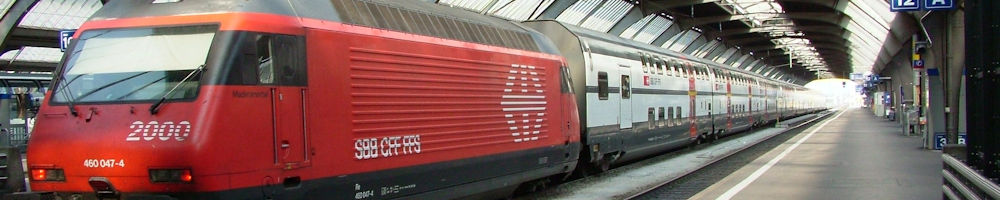
Swiss Railways train in Zurich Station

I led a party of UK transport enthusiasts who visited Marseille by rail between May 6th and 13th 2026.
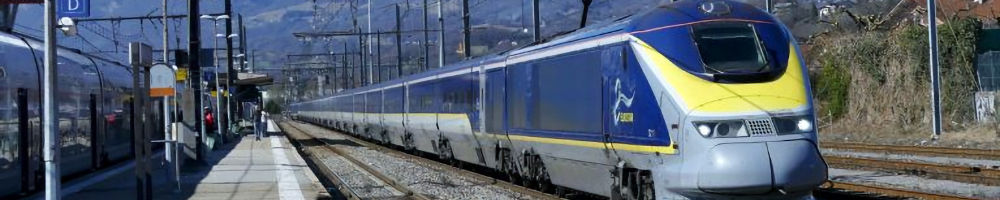
We took Eurostar to Lille Europe and although there was a sizeable queue at St Pancras International, it was constantly moving, so we all got through the controls in good time. The return experience at Lille Europe exiting from the Schengen area was also reasonably swift.
After lunch in a brasserie, we intrepid travellers then boarded Ouigo, the “no frills” low-cost SNCF train from nearby Lille Flandres station. There is no catering on Ouigo so it is best to obtain at least a drink beforehand. while there is a charge for excess baggage, our travellers had prepared for that. Ouigo is operated by specially branded TGVs, using the same high-speed lines as a normal high-speed train taking the same time. On the way back, however, delays in Provence meant that we were about half an hour late arriving in Lille Flandres. The large number of passengers already waiting to board the southbound Ouigo service rather impeded a swift exit from the platform for us.
Our time in Marseille was blessed with warm spring weather. We used the opportunity to visit churches, museums, art galleries, the Corbusier house, a concert in the oldest abbey in Europe and other attractions. Excursions were also made to Aix-en-Provence, the resort of La Ciotat and the ancient city of Arles. Highlights included the beautifully kept station at la Ciotat (where in 1895 the Lumiere brothers had produced one of the earliest films of a train arriving with visitors). Apparently, they thought their invention would just be a short-lived novelty… An efficient and remarkably cheap bus service links the station to the seafront and historic port area.
To reach Arles we took the scenic route – the non-electrified line from Marseille to Miramar that hugs the coast to Fos-sur-Mer passing lakes and woods, through tunnels and over viaducts, with some stunning views. It was not completed till 1915. The line deserves to be better known, and a proper timetable would be welcome.
Indeed, there were also places where clearer and simpler street maps for visitors arriving by train could be provided.
Public transport within the Marseille conurbation was considered to be good value for money and the group made good use of the 24-hour tickets. There are two modern metro lines, both serving the main line St Charles station on the top of a hill and three tram lines, one of which has a section in tunnel at Noailles.. Marseille once had an extensive tram network which had been largely closed down by the 1980s, with the exception of the line with the tunnel. However, in recent years two completely new lines have been built so our group made good use of them.
Also to be recommended was the bus route along the corniche to the suburb of Prado – where it connects conveniently with the metro. Some of us also took a boat trip round the island on which the famous Chateau D’If is situated. Several other boats also ply these coastal waters and are not part of the urban transport network, so you have to pay extra to use them.
Us British visitors found Marseille (which most had not visited before) to be attractive, memorable and catered for many tastes and interests – and with only one change of train from London!
One should also add that other means of transport between London and Marseille are also available. For example, a party of rugby fans in our hotel had flown down from London for the weekend. For rail users there are also two normal “full service” TGVs each way between Brussels and Marseille, calling at Lille Europe.
Trevor Garrod