
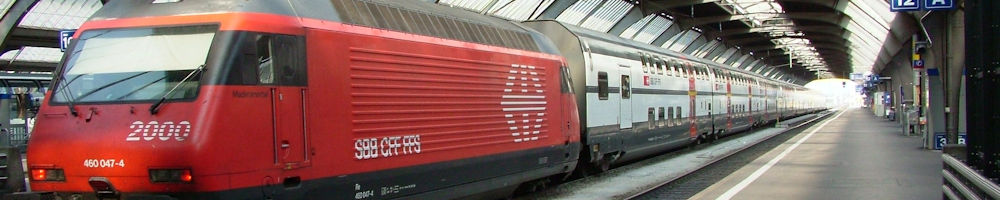
Swiss Railways train in Zurich Station





Since the days of Boat Trains when just about anyone travelling to the continent went by ferry(and you could easily book to cross Europe by train from any Thomas Cook Agent on the (High Street), we have arrived at a situation where unless you are in a car nearly everyone flies or uses Eurostar. For some decades now those wishing to travel by train and ferry have been ignored, or even prevented in the case of Dover which apparently has difficulty in coping with ‘foot passengers’. Passengers now have to make their own train and ferry arrangements.
STENA & DFDS:
One exception is Stena Rail – Sail from Harwich to the Hook (and also across the Irish Sea) a survival from the days when BR ran ferries as well as trains and where Rail Sail was intended to promote rail and ferry travel. It still represents very good value and gives the passenger one ticket which is valid on trains and ferry. Finally, the tide seems to be turning again with DFDS actively promoting rail connections on their Newhaven Dieppe route.
BRITTANY FERRIES:
Another recent convert to Rail – Sail is Brittany Ferries who now promote this on their web site and app but sadly their only discount/inclusive tickets are with Irish Railways for students. Otherwise through tickets are not available and you are directed to railway apps for tickets. Guidance to get you to and from the railway stations from the ferry port and for onward travel is limited. Brittany Ferries routes are ideal for travel to the west of France and potentially the south of France by avoiding Paris. But SNCF and the apps seem determined to funnel everyone through the capital and their expensive and often fully booked (unless arranged well in advance) high speed TGV’s.
With some knowledge and persistence you can find cheaper,slower regional trains that avoid Paris and don’t require reservations. Brittany Ferries have routes from Portsmouth or Plymouth to Roscoff Caen, Cherbourg, and St Malo, all of them connect with train stations sometimes with a short bus or taxi ride. I’ve also found its surprisingly straight forward to take advantage of the more relaxing and I’m tempted to say, more civilised journey, that a ferry offers. It is now easier to travel by train and ferry (with the exception of Dover) than it was just a few years ago. Although it takes longer there are considerable advantages. It can be cheaper than Eurostar, it’s certainly more pleasant than flying and there is also a more relaxed passage through passport and customs controls. Night Trains are becoming ever more popular but I’ve found there’s nothing quite like a night ferry for a relaxing nights sleep, refreshing you for the day ahead in France. The journey becomes much more part of the travel experience as you slowly unwind to the less hectic pace of life in France.
PORTSMOUTH to ST MALO & RETURN:
Brittany ferries recommend using SNCFConnect / Rail Europe for rail travel. It is also possible to book both U.K. and continental tickets through Trainline and similar well known U.K. apps which are easier to use and offer a better choice if avoiding Paris. The more adventurous can train/ferry it to Santander or Bilbao on Brittany Ferries and experience the scenic metre gauge railway that runs along the North coast of Spain.
I’ve focussed on the Portsmouth to St Malo route which I have used several times using train and ferry. It is currently not a well used path and I found myself accompanied by no more than a handful of “Foot passengers”doing the same journey. Travelling from London, trains to Portsmouth are frequent from Waterloo. I normally buy an off peak return as it gives plenty of flexibility on the return due to the variable time required to exit the ship and port these days. Portsmouth and Southsea Station is a leisurely 30 minute walk from the port and easy to navigate through the pedestrianised town centre. It’s not well signposted so I use google maps as a guide. However there is also an excellent and frequent bus service which departs from the City Shops South stands D or E just a couple of minutes walk from the station. Again you can use Google maps for bus timings. Several buses including services X4 and X5 with a journey time of around 7 minutes take you to the port entrance where its just a couple of minutes walk to the terminal. If you have a lot of luggage taxis are readily available at the station.
Once registered as a foot passenger you join the others at the terminal to access the port controls. On the overnight sailing you are often boarding a couple of hours before the boat departs. You are taken as a group to the boat by a port bus. The terminal has a cafe for snacks or a light meal. Ferry fares vary for foot passengers but appear very good value from £50 to £75 depending on the time of year. Travelling overnight requires you to use a cabin, which costs a bit more for a single person but is good value for two or more travelling together. I find the overnight ferry to France the best option as you arrive refreshed in the morning with the day ahead. However you can return on the day ferry from France and book overnight accommodation in St Malo or Rennes. Brittany ferries defines the journey as a mini cruise and the dining experience on board definitely adds to the occasion.
Arriving at St Malo in the early (but not too early) morning is delightful. It is a small port and has many historic features and an iconic town facade which can be seen from the boat. Alighting from the ferry to the terminal is by bus which currently leaves from deck 3. Although the ferry arrives at a booked time alighting is variable depending how busy it is.Port and customs clearance I have found quite quick and fairly relaxed, compared to flying or exiting the larger ports. There is a number 8 bus connecting the rail station and the port, but it only runs once an hour. Walking takes around 25 minutes and is very straight forward using google maps. Taxis can also be ordered from the Brittany Ferries desk at the port if none are waiting. From the station all trains go to Rennes. As with many French provincial rail services there are several trains between 6am and 9am and after that there are around one an hour. Whilst disembarkation time from the ferry is variable these days I have always managed to be on the station at the latest in time for the 10.27 train even when walking. Train tickets must be purchased before departure either at the booking hall in St Malo or simply online via any of several apps including Trainline. There is an ordinary single which enables you to travel on any TER train. Apps don’t always indicate this as they give you a specific time which you can ignore unless it’s an advance purchase or a Ouigo high speed train (3 a day in each direction) which requires a train specific ticket.
Rennes, an hour away is also the gateway to the rest of Brittany and France via trains and the regional buses (which handily leave from the bus station, adjacent to the railway station). Managed by the regional transport authority Breizhgo these buses are often the replacement for long closed rail services. If you require a bus you can purchase a ticket from the bus booking office at the bus station or on the bus. I downloaded the Briezehgo app (in English) and purchased my tickets with it.
Regional train services which had been poor and in slow decline are now improving thanks to Breizhgo. Trains are also much easier to book these days via apps and ticket machines so it’s very similar to a UK ticket purchase. Booking offices are often very busy with long queues. Dynamic pricing is now very much part of SNCF so you might even find some bargains. However demand for tickets often outstrips supply on TGV’s so it can be difficult to find a seat at full fare let alone a discount on the day. Regional trains are normally reservation free.
The return journey from St Malo to the port is a little easier as the number 8 bus leaves from outside the train station to St Servan Town hall and from there it’s a pleasant short walk to the ferry port and follow a similar process for your departure. On arrival at Portsmouth the time taken to disembark is also variable these days. Currently work is underway to renovate the passenger walkway so alighting from the boat is by port bus. You have to wait for the lorry deck to be empty first. (This is why an off peak train return to London is easier than an advance purchase as timing is variable). Buses to the station depart from the far side of the expressway but are quite easy to locate. Again I prefer the gentle stroll through the town centre.
To conclude, using train and ferry is a great way to arrive in France and is so much more relaxing than either flying or even travelling by Eurostar (and often comparable in price especially if travelling to the west or south of France) and you avoid all the queues too!